

Table of Contents
- Why Riders Look for Fasthouse Alternatives
- How to Choose Off-Road Riding Gear That Lasts
- Durable Off-Road Riding Apparel: What Holds Up on the Trail
- UPF-Rated Adventure Clothing for Hot Weather Riding
- Budget vs. Premium Off-Road Gear Tiers
- Veteran-Owned Off-Road Gear: What to Look For
- Gear Maintenance and Long-Term Durability
- Conclusion: Picking Your Fasthouse Alternative
- Frequently Asked Questions
Last Updated: October 4, 2026
Why Riders Look for Fasthouse Alternatives
Riders hunting for the best fasthouse alternatives for off-road gear usually aren't chasing a logo. They're chasing gear that survives a full season of dust, sweat, and wash cycles without falling apart at the seams.
Fasthouse built its name on moto-inspired style, and plenty of riders still love the look. But style alone doesn't keep you cool at hour six on a July trail ride, and it doesn't hold up when you're dragging a knee through rock gardens.
The factors we cover below, from fabric weight to stitching, decide whether your jersey lasts.
How to Choose Off-Road Riding Gear That Lasts
Start with the fabric and the fit, not the graphic. A jersey that wicks sweat and moves with your shoulders will outperform a heavier one that looks tougher but traps heat.
Look for moisture-wicking synthetics over cotton for active riding. Cotton soaks up sweat and stays wet, which chills you on descents and weighs you down. Polyester blends dry fast and hold their shape.
Then check construction. Reinforced stitching at stress points, stretch panels under the arms, and a cut that doesn't bunch when you're standing on the pegs all separate real riding gear from fashion.
Fit, Ventilation, and Impact Protection
Athletic fit keeps fabric close without restricting movement. It reduces snag risk and stops sleeves from catching on branches or handlebars. Comfort fit gives more room for layering in cold weather but can flap at speed.
Ventilation matters most in summer. Mesh panels across the back and underarms move air while you ride. Impact protection, whether built into the garment or worn underneath, should sit where you actually fall: shoulders, elbows, and ribs.
Durable Off-Road Riding Apparel: What Holds Up on the Trail
Durability comes down to three things: fabric weight, stitch quality, and abrasion resistance at contact points. Gear that skimps on any of the three tends to fail within a season.
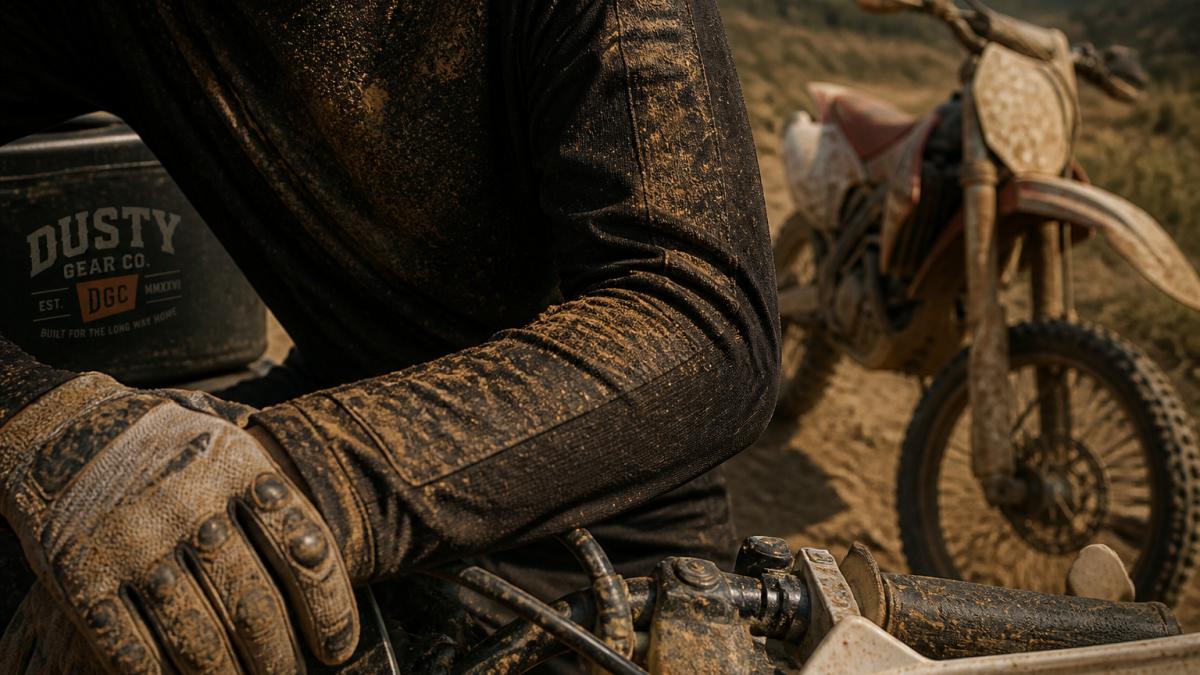
Reinforced stitching at the shoulders and knees is the first thing to check. Double-needle seams outlast single-stitch construction, especially where fabric meets elastic. Stretch panels at the hips and knees let pants flex without tearing.
Abrasion resistance matters most on pants and gloves. Look for heavier weave at the knee and seat, where you make contact with the bike and the ground.
| Gear Piece | What Fails First | What to Look For |
|---|---|---|
| Jersey | Underarm seams | Gussets, flatlock stitching |
| Pants | Knee and seat | Reinforced panels, stretch zones |
| Gloves | Palm and fingertips | Double-layer palm, silicone grip |
| Boots | Sole and buckle | Replaceable soles, metal hardware |
UPF-Rated Adventure Clothing for Hot Weather Riding
UPF-rated adventure clothing is fabric tested to block a set percentage of UV radiation. A UPF 30 rating blocks roughly 97% of UV rays, while UPF 50 blocks about 98%. That difference matters on a five-hour exposed ride.
For hot-weather riding, UPF protection beats sunscreen alone. Sunscreen sweats off, needs reapplying every couple of hours, and misses spots. A long-sleeve UPF hoodie covers your arms and neck for the whole ride without reapplication.
Dusty Gear Co's WORK HORSE UPF 30+ Performance Work Hoodie is built for exactly this: a 5 oz. polyester performance fabric with a three-panel hood, moisture-wicking properties, and an extended drop-tail hem that covers your lower back when you're bent over the bars.

Moisture-Wicking Fabric and Breathability
Moisture-wicking fabric pulls sweat away from your skin to the surface, where it evaporates. Breathable fabric lets heat escape instead of trapping it. Together, they keep your core temperature stable when the trail turns technical.
Polyester moves moisture best. Blends with a small amount of spandex add stretch. Cotton is the wrong choice for hot-weather riding because it holds moisture against your skin.
Ventilation zones, mesh under the arms, and a loose enough cut to allow airflow all help. So does color: lighter fabrics reflect heat rather than absorbing it.
Budget vs. Premium Off-Road Gear Tiers
The price gap between a $40 jersey and a $120 jersey is rarely about the graphic. It's about fabric weight, seam architecture, and how many wash-and-ride cycles the piece survives before the underarm seam blows out or the knee panel abrades through.
Here's what actually separates the tiers, based on the construction details you can verify on a spec sheet or by turning the garment inside out:
| Tier | Typical Jersey Price | Typical Pant Price | Fabric & Construction Markers | Realistic Lifespan |
|---|---|---|---|---|
| Budget | $30-$55 | $70-$120 | 4-5 oz. polyester, single-needle seams, no gussets, screen-printed graphics that crack | 1 season of casual trail riding |
| Mid-tier | $55-$90 | $120-$200 | 5-6 oz. polyester/spandex blend, flatlock or double-needle seams, underarm gussets, sublimated graphics | 2-3 seasons of regular riding |
| Premium | $90-$150+ | $200-$350+ | 6-8 oz. abrasion-resistant weave, bonded or taped critical seams, articulated knees, stretch panels at hips and yoke | 3-5+ seasons, with repairs |
What you're actually paying for as you move up:
- Fabric weight and weave. A 4 oz. jersey feels cool and dries fast, but it snags on brush and stretches out at the collar within a season. A 6 oz. abrasion-resistant weave resists branch strikes and holds its shape through repeated wash cycles.
- Seam construction. Single-needle seams are the first failure point on budget jerseys. Flatlock stitching lies flat against the skin and distributes stress across more thread, which is why it shows up on mid-tier and premium pieces at the underarm and shoulder.
- Gussets and articulation. An underarm gusset or an articulated knee lets the garment move with you instead of pulling against the seam. This is the single biggest comfort upgrade between budget and mid-tier.
- Sublimated vs. screen-printed graphics. Sublimation dyes the fabric itself, so the graphic never cracks or peels. Screen printing sits on top of the fabric and is the first thing to fail on a budget jersey after a dozen washes.
Where to spend and where to save:
Gloves and pants take the most abuse, palm contact, knee drags, seat friction, so put your money there first. A mid-tier pant with reinforced knees will outlast a premium jersey every time in terms of cost-per-ride.
The honest math: if you ride 40 weekends a year, a $150 mid-tier pant that lasts three seasons costs you about $1.25 per ride. A $90 budget pant that fails after one season costs $2.25 per ride. The premium piece is cheaper in the long run, but only if you actually ride enough to wear it out.
Veteran-Owned Off-Road Gear: What to Look For
Ownership story is not a spec sheet.
A practical evaluation checklist for any brand, veteran-owned or not:
- Published fabric specs. Can you find the fabric weight in ounces per square yard, the fiber blend, and the finish (moisture-wicking, UPF, abrasion-resistant)? If a brand won't publish it, assume the worst.
- Stitch type at stress points. Look for flatlock or double-needle construction at the underarm, shoulder, and knee. Single-needle stitching at these points is a red flag regardless of who owns the company.
- Reinforcement mapping. Pants should show reinforced panels at the knee and seat. Gloves should show a double-layer palm. If the brand can't tell you where the reinforcement is, it probably isn't there.
- Warranty and repair policy. A brand that stands behind its product will publish a warranty term and, ideally, offer a repair service. A one-line "satisfaction guaranteed" with no specifics is marketing, not policy.
- Return window and shipping terms. A 30-day return window on unworn gear is standard. Anything shorter is a signal about how much confidence the brand has in its sizing.
- Sizing transparency. Published chest, waist, and inseam measurements, not just S/M/L, let you order once and get it right.
Why veteran-owned matters at all:
A common pattern among veteran-founded gear brands is a bias toward functional simplicity, fewer decorative features, more attention to the parts that fail. But it's a tendency, not a guarantee.
How to verify the claim itself:
The term "veteran-owned" is not a regulated certification. Some brands are verified through third-party business registries; others self-apply the label.
Applying this to your shortlist:
Run every candidate brand, including Dusty Gear Co, through the six-point checklist above.
Gear Maintenance and Long-Term Durability
How you care for riding gear determines how long it lasts. Most premature gear failure traces back to washing mistakes, not trail abuse.
- Wash in cold water with mild detergent
- Skip fabric softener entirely (it clogs wicking fibers)
- Turn garments inside out before washing
- Air dry instead of machine drying
- Inspect seams and zippers after every few rides
- Repair small tears before they spread
- Store gear dry, never damp
Zippers and buckles wear out before fabric does on most pants. A quick wipe-down and a drop of lubricant on metal zippers keeps them working for years.
Conclusion: Picking Your Fasthouse Alternative
The best fasthouse alternatives for off-road gear aren't about finding a clone. They're about finding apparel built for the riding you actually do: breathable fabric for hot days, reinforced stitching for trail abuse, and UPF protection for long exposure.
If you want a starting point, look at Dusty Gear Co's lineup. The WORK HORSE UPF 30+ Performance Work Hoodie handles sun and sweat on long days, the Basecamp Duffle carries your gear from trailhead to camp, and the graphic tees are built for the post-ride crowd. Free shipping kicks in over $120.

Shop Dusty and gear up for the long way home.
Frequently Asked Questions
What brands are similar to Fasthouse for motocross gear?
Riders looking beyond Fasthouse often want the same trail-ready look with different pricing or construction. Veteran-owned brands such as Dusty Gear Co build graphic tees and UPF-rated apparel for off-road use, including the Men's "This Is My Wheeling Shirt" Graphic Tee at $36.00 and the WORK HORSE UPF 30+ Performance Work Hoodie at $59.99. Compare fabric weight, stitching, and sun protection before you switch, since moto jerseys and lifestyle tees serve different jobs on the trail.
Is Fasthouse gear good for trail riding?
Fasthouse gear is built around motocross and dirt bike culture, so jerseys and pants are cut for riding position and ventilation. For trail riding specifically, check whether the piece offers breathable fabric, moisture-wicking performance, and enough coverage for brush and sun exposure. Many riders mix a moto-style jersey with a UPF-rated layer for long days, since trail riding often means slower speeds, more stops, and more hours in direct sun than a moto race.
What features should I look for in off-road riding apparel?
Prioritize breathable fabric and moisture-wicking construction for hot weather, reinforced stitching at stress points, and stretch panels where you need movement. For sun-heavy trail days, UPF-rated adventure clothing adds coverage that sunscreen alone cannot match over a full day. Look at fit too: an athletic fit keeps fabric from snagging on handlebars or brush, while a looser cut may be more comfortable for casual trail riding. Durability comes down to fabric weight and how seams are finished.
Are there veteran-owned brands for off-road gear?
Yes. Dusty Gear Co is a veteran-owned brand making UPF-rated apparel and durable gear for off-roading, hiking, and fishing. Their catalog includes trail graphic tees at $36.00, the WORK HORSE UPF 30+ Performance Work Hoodie at $59.99, and duffle bags like the Tan Dusty Expedition Duffle at $67.99. Free shipping applies on orders over $120, which matters if you are outfitting a full riding season at once.
What is the best breathable gear for hot weather off-roading?
Look for moisture-wicking fabric, ventilation panels, and lightweight construction rather than heavy cotton. The Dusty WORK HORSE UPF 30+ Performance Work Hoodie uses 5 oz. 100% polyester performance fabric with moisture-wicking and odor-fighting properties plus UPF 30 sun protection, which suits long, hot days outside. Pair breathable layers with a moisture-wicking base and avoid dark, heavy cotton for riding, since it holds sweat and dries slowly.